
Ever since our honeymoon, which we of course spent at the World Cup in Brazil, the missus and I have developed a particular penchant for attending the major football tournaments when they come around. Our usual approach is to pick some location(s) in the first week of the tournament (as the better half says, when everyone is still happy!), put in for tickets and then go to any matches we are lucky enough to be successful with in the ballot.
Having our plans impacted by the rescheduling of Euro 2020 as a result of the pandemic and having some previous experience of Germany’s legendary football fan culture, we were absolutely champing at the bit to get to Euro 2024. We were lucky in our ticket application, securing tickets for one match in each of the cities that we really wanted to visit: Berlin and Munich.
We arrived in Berlin late Thursday afternoon and got acclimatised with a few big beers in the hotel bar before heading off for an enormous German-style feed up. It all tasted very nice but both of us were struggling to move for the rest of the evening!
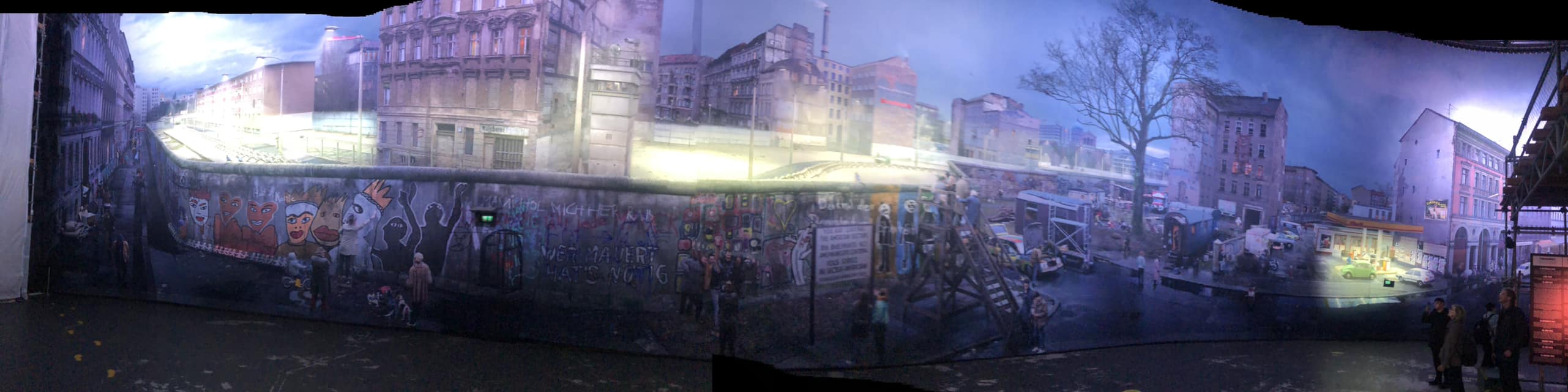
On Friday morning we headed down to have a look at the Brandenberg Gate and Checkpoint Charlie. Just across the road from the former border crossing is a huge panorama of an artist’s impression of what life was like on both sides of the wall during the height of the Cold War. It was actually fascinating and showed just how different life must have been between the liberal west and the communist-ruled east.
A trip to the forest to discover a club that has kept its “true soul”
In the afternoon thanks to a completely unexpected bit of good fortune due to the better half’s work contacts, we managed to book a tour of 1. FC Union Berlin’s throwback style ground Stadion An der Alten Försterei. If you haven’t heard of this quirky club from the former German Democratic Republic, it really is quite some story.
Union’s (officially pronounced “oon-yawn” never “yoo-nyon”) evolution, as detailed in Kit Holden’s excellent book: “Scheisse! We’re Going Up! The Unexpected Rise of Berlin’s Rebel Football Club.”, is simply incredible and has a real resonance with those of us that follow lower league clubs who have not only been through turmoil and survived, but who harbour ambitious hopes for future success. They might be further ahead in their development but there are some very real parallels with how Leyton Orient were brought back from the brink and have aspirations of becoming a second tier stalwart.
The origins of Union can be traced back to 1906 when its predecessor FC Olympia Oberschöneweide was founded. Union came into being as a result of the reorganisation of East German football in 1965-66. However they spent most of their formative years bouncing between the top two tiers of the DDR’s Oberliga. They did however develop a bitter rivalry with the Stasi (East German Secret Police) backed BFC Dynamo- a name Union fans still refuse to utter.
It was after the reunification of Germany in 1990, with them placed in the third tier of German football, that Union’s story really started to evolve. They had always been seen as a club for the misfits and rebels of East German society, but near financial collapse saw the fans step in and really drive the club forward.
In 2004 with the club at risk of losing its league licence and being demoted back to non-league football, the fans led a massive fundraising effort, the central and probably most famous element of which saw fans giving blood and donating the compensation fee to the cause. The fans literally gave their blood to save their club!
By the turn of the century Union’s famous old ground was pretty much unfit for purpose and plans were drawn up for a comprehensive refurbishment. However with hardly any money the fans (more than 2000 of them and almost all volunteers) carried out the majority of the work themselves.
In 2019 Union were promoted to the Bundesliga (top tier) for the first time in their history, the daunting realisation of what they had achieved led to the title for Kit Holden’s book. In only their second season in the top flight, Union finished 7th after a win over the much-despised RB Leipzig and qualified for the inaugural UEFA Conference League. Although the stadium’s limited capacity of just over 22,000, with most of that being terracing, meant they had to play their home games at the Olympic Stadium home of their rivals from the west of the city, Hertha.
As if that wasn’t enough, Union then qualified for first the Europa League and then, most unbelievably of all, the Champions League Group Stage in 2023. While things didn’t go quite so well last season, they survived thanks to a stoppage time winner against Freiburg in the last match of the campaign.
Their continued success means that the club and the fans are constantly having to balance the need to generate sufficient revenue, with protecting the true spirit and soul of the club. This is something that they are just about managing to do, although it has to be said that there was plenty of Union-branded merchandise on display at the city’s airport, and there are apparently plans in development for a complete rebuild of the famous old ground.
However perhaps the most shining endorsement of the club and its supporters is the fact that they don’t see it as being about winning or losing, it is about the experience of catching up with your mates and being at Union. They even have dedicated fan “rules” which set out the expected behaviour: 1) Never boo your own team, 2) Never leave before the final whistle, 3) Never make a scape goat of an individual, 4) A hoarse voice is the Union fan’s equivalent of the players’ aching muscles.
While setting strict rules goes very much against the grain for most true-spirited football fans and especially a “rebel” club such as Union, the togetherness of the supporters provides a timely reminder, in the money-mad world of modern football, of just why we fell in love with our clubs and going to football matches in the first place.
After visiting this very special club (and with massive thanks to @sweetman_jacob for his fascinating, insightful, and downright hilarious tour), we are desperate to go back and take in a match there, although of course football tourists aren’t necessarily the most welcome at the Stadium at the Old Forester’s House!
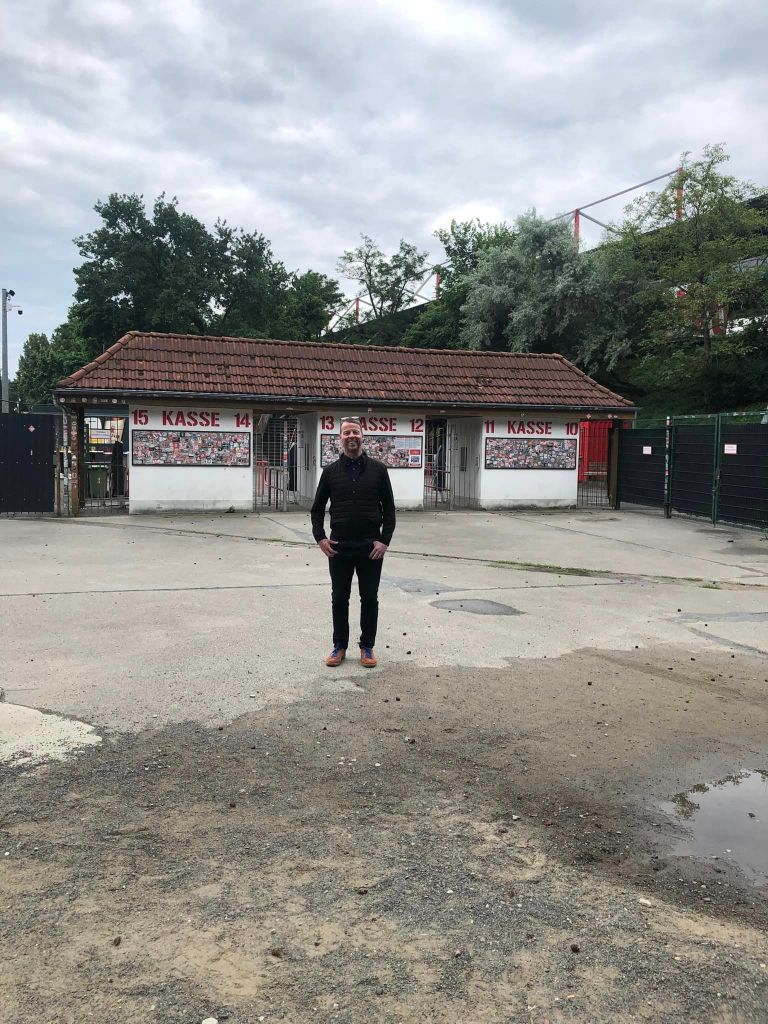
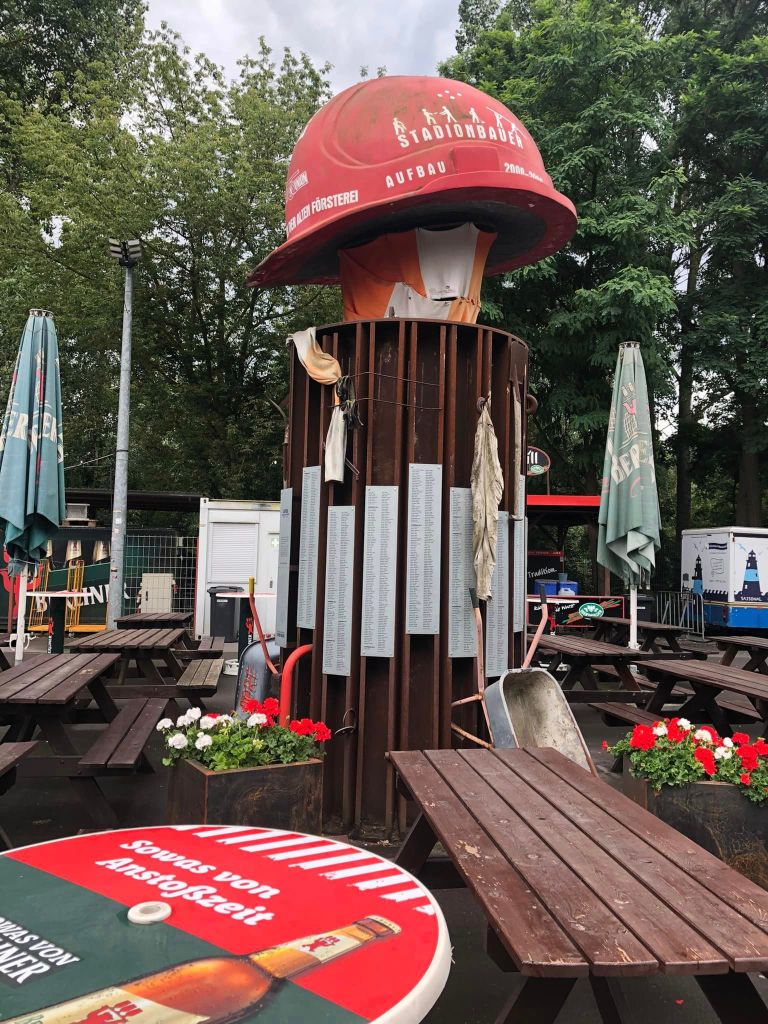
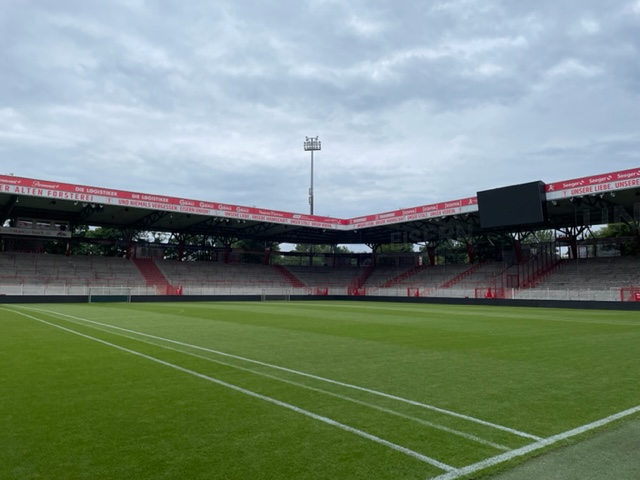

Stadion An der Alten Försterei: The quirky home ground of the simply incredible 1. FC Union Berlin
The great Euro 2024 party gets underway
We arrived back at our hotel in plenty of time to settle in the bar for the opening match of the tournament between the hosts and Scotland. As the match got underway it came as something of a surprise, given we were in a country famed for its efficiency(!), to find that the audio was vastly out of sync with the TV pictures. This made for quite interesting viewing when we heard a cheer and then had to wait for a minute or two to see what was happening on the big screen. There was a smaller screen with a slightly shorter delay at the back of the bar, but even that was a beat or two behind. Modern technology hey!
As we were to discover throughout the week, the 5-1 hammering that Germany handed to Scotland, did nothing to dampen the spirits of the travelling Tartan Army hordes. They were simply everywhere in Germany, even in cities like Berlin where they weren’t even playing, but as usual, other than the sheer quantity of beer, and every other form of alcohol they could lay their hands on, that they put away there wasn’t even so much as a hint of trouble.
With our first live match, Spain v Croatia, scheduled for 6pm on Saturday, we had plenty of time to do some more tourist stuff in the morning, and we opted for a Cold War walking tour. Almost as soon as we had arrived at the meeting point for the tour it started to rain, however an organised group of joggers raised the spirits of all those waiting for tours by insisting that it wasn’t actually raining (that badly!) and asking why we didn’t join them?
For those of us that grew up in the 70’s and 80’s, the Cold War played a significant role in our lives, mainly due to the ongoing threat of nuclear Armageddon. The tour provided an emotional and at times horrifying glimpse into what life was like in a divided city. Our guide, Maria, was excellent and being of half Swedish/ half Japanese origin she was uniquely placed to give us an honest insight.
As we looked at a remaining section of the infamous Death Strip- an area in the middle of the two walls littered with watchtowers, traps and other obstacles, with the sole intention of preventing anyone from fleeing the East, I couldn’t help but wonder what the whole point of the hostile separation was? It felt especially pertinent as Ukraine would be featuring in our second match of the tournament in a couple of days’ time.
After the tour we headed back to the hotel for a quick refresh (yes that’s right a couple of big beers in the bar!), where we bumped into a group of lads from Bristol, almost all City rather than Rovers fans, which allowed us to bond to a degree by taking the mickey out of their local rivals and their “interesting” ground. Apparently given the difficulty in getting flights, they had just arrived in Berlin and were off to Gelsenkirchen very early the following morning for England’s game there in the evening.
Having experienced what it can be like getting into the stadium at these big tournaments previously, we decided to make our way to the ground nice and early via an opportune stop for a currywurst at the station. If you haven’t had the experience, currywurst is a popular fast food snack that was invented just after the war in Berlin. It is basically a typical German sausage drizzled in a seasoned ketchup and sprinkled with curry powder. The missus despises the very concept of it, although that may be due to a New Years Day hangover in Berlin a good few years back(!), whereas I am a huge fan. That probably says as much about my gastronomic tastes, or lack thereof(!), as anything else!
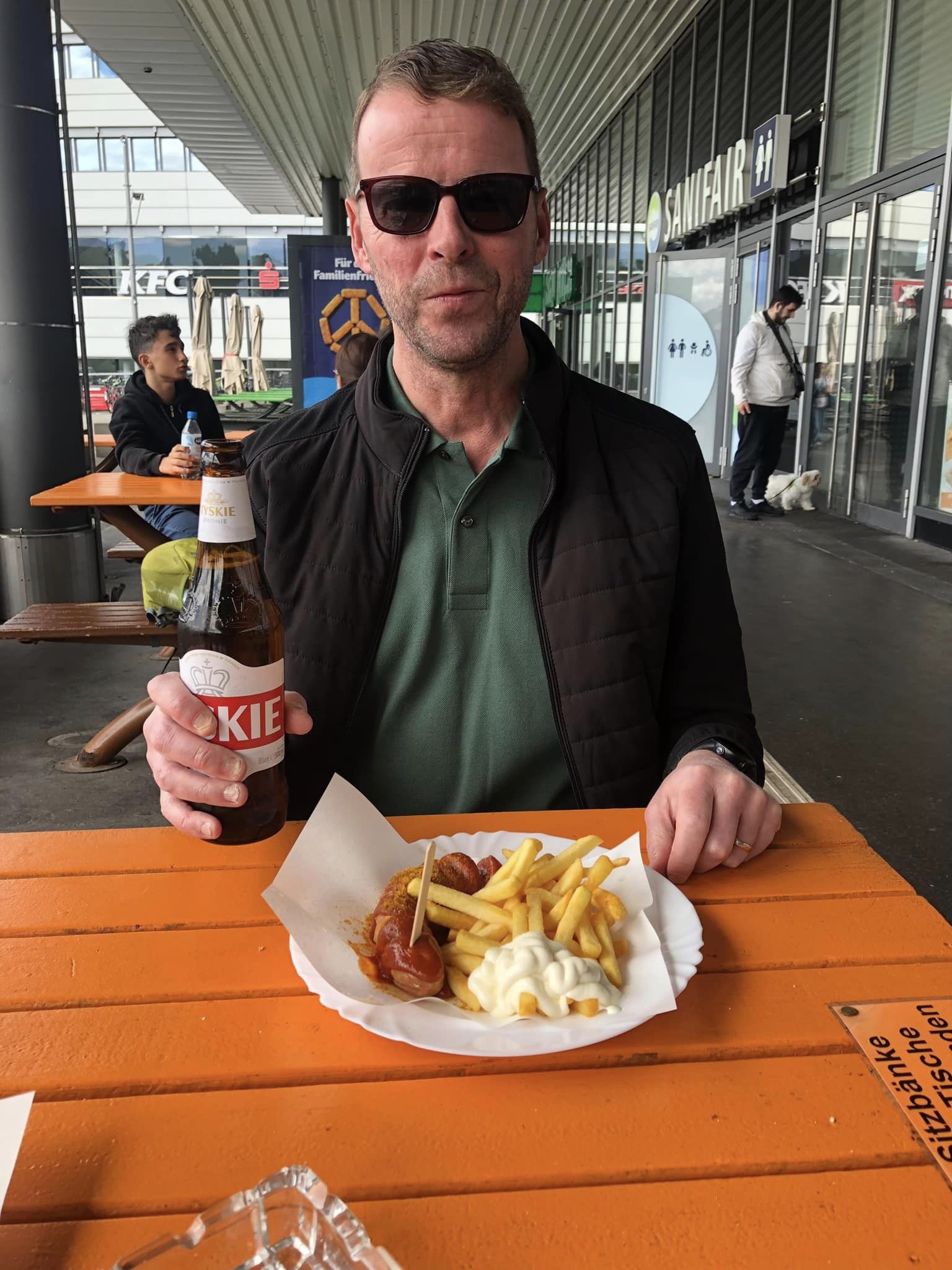
Your author sampling the local cuisine
It was easy enough to get the S-Bahn to the Olympic Stadium, and even better, not only could you buy a bottle of beer on the platform and drink it on the train, but they also had handy empty crates on the platform when you arrived in which to deposit the bottles. Can you imagine British football fans being trusted like that? We shared the journey with some very drunk and very loud Croatia fans, but it only served to help the pre-match atmosphere.
As soon as we exited the station there were stalls to buy beer, wurst, and handily enough for our new Croatian mates, miniature bottles of Jägermeister as their supplies of alcohol had taken a hit on the way over.
It was a tree-lined approach to the stadium and just as we turned off to make our way to our nominated entry gate there was a very ideally placed biergarten where we could finish off our beers and soak up some of the pre-match atmosphere. There was a good mix of both Spain and Croatia supporters, and a healthy spattering of neutrals. The only hint of trouble was a flare ignited by one Croatia fan, but he kept away from most of the rest of the fans in the bar.
It might just be me, but the Olympiastadion in Berlin always carries with it the haunting memory that it was built during Hitler’s reign as the venue for the 1936 Olympic games and the famous history in which US athlete J.C. “Jesse” Owens “single-handedly crushed Hitler’s myth of Aryan supremacy” by winning four gold medals. There was also the shameful incident when ahead of a friendly match in 1938 the England football team, including a certain 19-year old Stanley Matthews playing in his first overseas international, were forced to do a Nazi salute after the FA bowed to pressure from the Foreign Office. Having said that, my football obsessive nerdy nature meant that I was still intrigued to see what it was like as a venue for a football match,
We headed to the entrance gate in plenty of time, but in another surprising example of German inefficiency, it took ages for each individual attendee to get their digital tickets scanned and gain access to the ground. As more and more fans started to arrive behind us, for a brief moment it started to feel a bit concerning. Thankfully more stewards came to help, and the process speeded up before the situation escalated.
Once inside the stadium grounds it soon became apparent that while the inside of the stadium had benefited from a significant refurbishment in 2004, the other facilities had largely been ignored. Portaloos and small and vastly overcrowded beer and sausage stalls on the grass area outside the stands was about all there was. Equally the approach to stewarding was simply to wave people in the vague direction of their block of seats while not doing anything about those standing in the entrances and gangways.
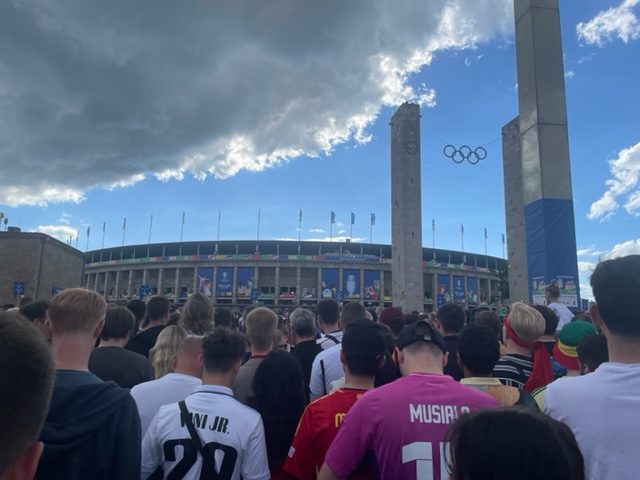
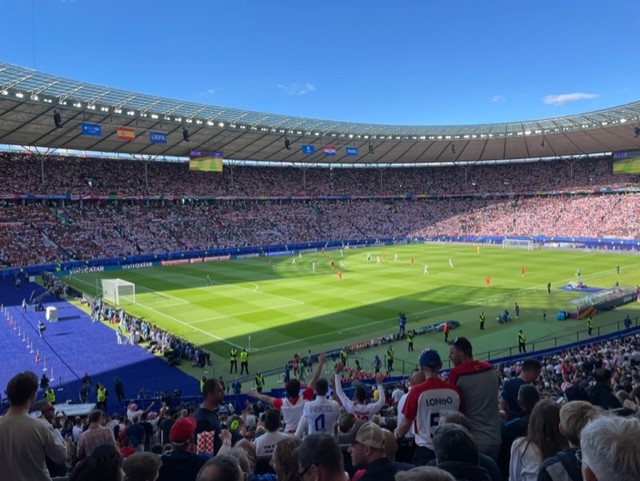
Olympiastadion Berlin – probably hasn’t changed too much since 1936!
Once the match itself got underway it was a pretty lively affair right from the start. The atmosphere from the Croatian fans in particular was absolutely bouncing until just before the half hour mark when Alvaro Morata gave Spain the lead. Then just three minutes later Fabian Ruiz made it 2-0. It was 3-0 through Dani Carvajal in added time at the end of the first half but we unfortunately missed that goal as we reckoned (quite correctly as it turned out!) that if we were to have any chance of getting a half-time beer we had better give ourselves a bit of a head start.
When we finally got back for the second half, Spain saw out the remainder of the match comfortably and secured maximum points. After the match we headed back to Friedrichstraße, where we had been that morning and watched Italy recover from an opening goal by Albania after just 23 seconds to win 2-1 in a French restaurant/ bar before heading to a crowded Irish bar just up the road. Just as we were getting ready to leave we bumped into the Bristol lads from the hotel that afternoon, who seemed to not even care that they had a train very early the next morning, as we didn’t see them the next day we have to assume they made it!
Look out for Part 2 to be posted on Friday when we head down to Munich, until then…
Up the O’s!
 football nerd
awesome story. I lookforward to reading part 2.
I will be visiting England soon. Unfortunately our itinerary was booked in before the season fixtures were released. Might see if I can squeeze in an away fixture
LikeLiked by 1 person