
It’s all my dad’s fault! The reason that Our Kid (my brother for the benefit of those of you that don’t hail from the north west of England!) and yours truly are completely hopeless football obsessives is because my Dad is and always has been one.
Throughout our childhood which was split between the Wirral, the Netherlands, the United States and Hertfordshire; alongside all sorts of cultural and educational visits and experiences, he made sure that we crammed in as much live sports watching as we possibly could. My dear mum was a willing accomplice (especially if it involved watching her beloved St Helens Rugby League Football Club), but equally I think she enjoyed the peace and quiet when the three of us were off watching something else.
While the three of us retain to this day what could best be described as an avid, if not completely uncontained, love and passion for rugby (league in all our cases and union for my father and brother), baseball and American football, it is football that truly binds the three of us together like nothing else.
While we differ in the teams we support: Roger (my dad) and Phil (my brother) share a season ticket on the Kop at Anfield and are both passionate Liverpool fans, while as most of you will know I am a former Arsenal season ticket holder who now follows the mighty Leyton Orient all over the country. Whenever the three of us are together we spend a not inconsiderable (ok, ok pretty much all!) of our time locked in enthusiastic discussion and debate about all matters concerning the beautiful game.
With my dad turning 80 this past December, Our Kid and I could think of no better way of marking the occasion than whisking him off to one of the cathedrals of European football, which of course would also prove the perfect city break for the pair of us as well. The only issue to be decided upon was where we would be headed?
The process we adopted was probably fairer and more equitable than the way that host countries for World Cups are decided these days, and the eventual shortlist encompassed all of: Budapest, Turin, Marseille, Madrid, Munich and Bilbao/ San Sebastian. After looking into fixtures, flights and potential accommodation the final two contenders were: Turin and Bilbao. We eventually plumped for Bilbao based purely on the fact that I had been there to watch matches previously and was pretty familiar with the script and set-up. Even better, when we revealed the destination to my dad over lunch on his birthday he confirmed that despite being very widely travelled, he had never actually visited the Basque country.
The second weekend in March was our chosen date when Athletic Club de Bilbao would be hosting RCD Mallorca but given the Spanish football authorities’ penchant for leaving the decision on when the fixtures in each round are actually going to be played to the last moment possible, we decided it would be prudent to go from Thursday to Monday. So it was that the three of us rendezvoused at Gatwick airport on the Thursday lunchtime.
The football fixture gods had very much worked to our benefit as they scheduled the Athletic Club match for the Sunday evening. While we had to reluctantly rule out a trip to Real Sociedad as they would be playing on the same day, second division and relatively nearby SD Eibar (pronounced Ay-bar), about whom I had just read Euan McTear’s excellent book “Eibar the Brave: The Extraordinary Rise of La Liga’s Smallest Team”, would be playing at home on the Friday evening. When I consulted the other chaps about whether they felt they wanted to go to that as well, it came as no surprise whatsoever when they both responded emphatically: why wouldn’t we?
We landed in Bilbao on Thursday afternoon and treated ourselves to a taxi for the short journey to our hotel, located conveniently within strolling distance of Bilbao’s renowned old town. After a brief regroup and the chance to unpack and settle in, we headed towards the old town.
Being dedicated culture vultures Dad and Phil are always keen to explore a museum whenever they get chance, so after walking for a while we decided to go into the first one we spotted. It’s fair to say that El Museo de Pasos de Bilbao, (or the Holy Week Procession Floats Museum- yes that is exactly what you think it is: a museum of highly ornate floats used in religious processions) wasn’t necessarily our ideal choice! We (hopefully!) feigned interest suitably to avoid insulting the very kind gentleman on reception before escaping and heading for a well-earned beer and some pintxos.
If you haven’t had the pleasure of visiting the Basque country and sampling the pintxos, they are basically small snacks, usually on a slice of bread, that offer all sorts of fabulous gastronomic delights. It is actually a bona fide Basque cultural activity to undertake a txikiteo (literally a pintxo crawl where you go from bar to bar sampling each one’s delights and having a beer, glass of wine, or the popular local tipple kalimotxo (a combination of cheap red wine and coke). If you do ever find yourself in Bilbao’s old town of an evening every night is party night when young and old sing, dance and laugh together, there is nowhere I have been quite like it.
The following day after a spot of breakfast – the first of what would become our go-to choice of jamon e queso bocadillos and coffee to start the day- given the train ride to Eibar was going to take over an hour and half we concluded we might as well make a day of it and stop somewhere en route. The place we opted for was the “world-renowned”(sic) town of Durango simply because it was roughly halfway, looked like the biggest place on the railway line, and if I am completely honest I quite liked the name as it conjured up images of old Western movies.
We arrived in Durango just before midday and set about exploring the sights. After visiting Santa Ana’s Arch, the Lariz Tower and the Kurutziaga Cross, and before anyone marked us down as enthusiastic religious tourists especially given the previous day’s museum experience, we decided it was time for a well-earned drinks break while Our Kid, being involved in the food industry by trade, set about looking up local restaurants.
Unsurprisingly, the one that came out top in his research was packed out, as were several other in the centre of town, it seemed most of Durango and the surrounding area went for lunch at the same time on a Friday as British football tourists! We eventually found a family-run place which while the bar at the front was standing room only had another more spacious dining room out the back. We may have overdone it slightly on the starters by ordering a sharing tapas plate each, but we polished off our delicious main courses, washed down with a bottle of red wine before heading off back to the station. Sophisticated pre-match preparation of the highest order!
The first thing that you notice when you arrive in Eibar is that it is basically on the side of some rather steep hills. With a bit of time to kill before kick-off and wanting to find out what cultural delights the town had to offer, we opted for a brief pause in the Laurel and Hardy pub (surprise, surprise!), literally across the road from the station.
It turned out that the town’s main tourist “hotspot” was the Arms Industry Museum, although to be fair our research revealed little else, which after so much time spent perusing religious artefacts and the like, felt like a suitable change of scene. It displayed the town’s and region’s industrial history, based on using the plentiful deposits of iron ore to craft armaments. As time has rolled on however this has grown to encompass all sorts of other products such as bicycles, Vespa scooters and irons to name but a few. Maybe it says something about us and our lengthening years, but all three of us actually found it quite interesting.
With our cultural activities completed for the day, it was time for pre-match preparation. As outlined previously, Eibar is basically on the side of some relatively steep hills so inevitably the way to the ground was upwards. About halfway up there is an escalator which takes you up past an old bull ring which has been converted to house a couple of 5-a-side pitches, once you reach the top then you can see the ground. Rather handily there are also a trio of traditional style bars.
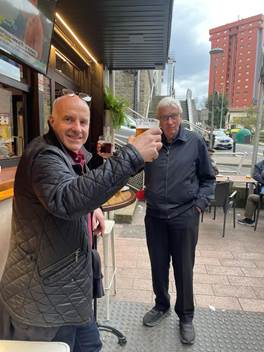
My Dad and Our Kid get match-ready at SD Eibar
For those of you not fully versed in the history of this Cinderella club, (and to be fair I knew very little about them until I read Euan’s book!), here is a brief summary of their incredible story.
Hailing from a town with a population of just over 27,000 and with a home ground, Ipurua, which at the time had a capacity of just 5,000, after a history knocking around the second and third tiers, this fan-owned club were quite amazingly promoted to La Liga (the Spanish top tier) in 2014. To provide some context on the size of the club: they celebrated their promotion with confetti that was originally produced by FC Barcelona to celebrate their potential title win that never happened that season. Thankfully the clubs play in similar colours!
Sadly after a season facing all of La Liga’s big-hitters and hosting Real Madrid, Barca, local much bigger clubs Athletic Club de Bilbao and Real Sociedad et al at Ipurua, Eibar were to finish 18th and were relegated. However at the end of the season, 13th placed Elche were demoted as a result of financial mismanagement and Eibar were reinstated in the top flight for a further season. They were to stay in La Liga for a total of 7 seasons before eventually returning to the Segunda (second division) where they remain.
One of the main supporters’ group is called “Eskozia la Brava” (Scotland the Brave) due to a self-proclaimed affinity with Scottish football fans. The official line given is that: “It’s a country where we admire their passionate support and the colour and the atmosphere that they bring to the ground. But the most important thing whether you win or lose, there’s always time for the post-match activities.” (Read: they like to drink copious amounts of Scotch whisky and are always up for a party!).
The ground itself has been fairly recently developed with the capacity expanded to just over 8,000 and is surrounded by trees, with a motorway passing by that you can see above one of the stands. It is a truly bizarre setting for a football ground but has good facilities and creates a hell of an atmosphere.
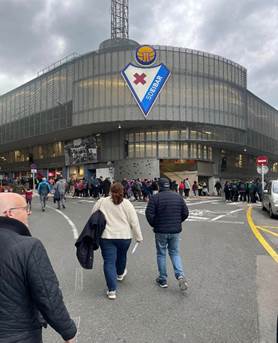
The Approach to Ipurua
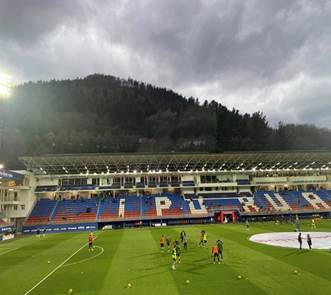
The view from our seats
The match was against SD Almeria who were just above Eibar in the table. Despite that Los Armeros (literally The Gunsmiths, surprise surprise!) took the lead in the sixth minute when Brazilian midfielder Matheus Pereira formerly on the books of Juventus and Barcelona, cleverly evaded two challenges on the edge of the area before firing home left footed. The celebrations all around the ground were amazing, with Eskozia la Brava behind the goal giving it the full works with some huge flags, confetti and the odd pyrotechnic.
While the rest of the game was fairly evenly matched with entertaining enough football, there sadly weren’t to be any more goals. As we left the stadium we couldn’t help but wonder to ourselves what level two mid-table Spanish second division teams might fit in back in England. The conclusion we reached was bottom of the Championship/ top of League 1. So if there is ever to be a European competition created for lower league clubs (and with UEFA anything is possible of course!), and it involved Leyton Orient I would more than happily return to watch the mighty O’s.
There was just time for a quick, and utterly delicious, toasted pork sandwich and a drink in a bar at the bottom of the hill before we got the train back to Bilbao. It was a very pleasantly surprising addition to our trip, and I would highly recommend it for any self-respecting groundhopper, football tourist, or just someone curious to see what this special club is all about.
The next day, even though there was no football on we decided that we might as well have a day out in Donostia / San Sebastián, which for those who don’t know it is a seaside town famed for its world-class culinary scene, particularly its pintxos and Michelin-starred restaurants. While the food all across the Basque country is outstanding this city ramps it up a level or two even higher.
While you can reach San Sebastián by train, it is much quicker and easier to get a bus, with the bus station in Bilbao being very handily located right near San Mamés, Athletic Club’s ground (more on that later of course!).
With our booked bus not due to leave until lunchtime we managed to fit in a quick visit to the Maritime Museum. While I do have some interest in boats, the sea and the Nervión River, the highlight for me was learning all about Athletic Club’s Gabarra- the barge that the club sail up the river on instead of an open-top bus parade to celebrate when they win a trophy- which I had read all about in Christopher Evans’ excellent book: “Los Leones: The Unique Story of Athletic Club Bilbao.”
With it being a Saturday afternoon the two Kopites in our party were more than keen to find a bar to watch Liverpool taking on Southampton back at Anfield. After a sumptuous late lunch of delicious tapas plates and pintxos, we found a suitable venue just up one of the side streets which even had three spare chairs in front of the TV. Liverpool won 3-1 while I learnt thanks to updates from the missus, back at Brisbane Road with her dad, and frantic constant checking on my phone that Orient had lost 2-1 to Northampton. Well, at least two of us were happy with the day’s football on the bus ride back!
When we landed back in Bilbao there was only one thing for it, and we jumped onto the metro and headed for the old town for a few drinks and a tour of more of the fantastic pintxos bars. At one point we ended up getting involved in a group dance in one of the squares where the two older fellas playing the music had what must have been approaching 50 plus people bobbing up and down and spinning around in semi-organised choreography. Well, I did tell you that they like to party in the old town!
On Sunday morning after the usual jamon e queso bocadillo and coffee breakfast, it was time to visit the city’s other main tourist attraction (alongside San Mamés of course!), the Guggenheim museum. While the three of us are in no way modern art aficionados, it is a fantastic experience and well worth a visit if you ever find yourself in Bilbao. Particular highlights being: “The Matter of Time” by Richard Serra- a series of massive, curved weathered steel sculptures that basically create a kind of strange maze; “Puppy” by Jeff Koons- a huge larger-than-life West Highland White Terrier covered in flowers outside the main entrance; a menacing 9 metre tall evil spider sculpture called “Maman” on the river bank; and all sorts of weirdly intriguing sculptures, video and LED displays, and of course paintings.
The better half back at home was over the moon when I found her “favourite” piece: “Iberia 1958”, literally an all-black painting with a tiny white space in the bottom left hand corner by Robert Motherwell which reflects the sombre atmosphere of Spain under Franco’s regime and the artist’s personal feelings of tragedy and despair, and sent her a photo.
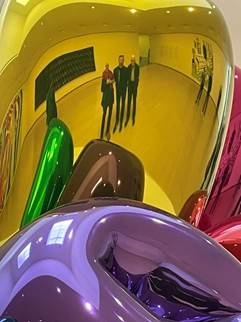
A modern art “selfie” at the Guggenheim
With our cultural palates sated sufficiently for a Sunday morning, it was time to get match-ready Bilbao-style, so I led us down to the old town for a spot of pintxo-based refreshment at the Peña Athletic del Casco Viejo Bilbao. The rough English translation of peña would probably be supporters club, however in Bilbao and the other regions that make up modern Spain it is so much more than that. This one smack bang in the middle of the old town is much more like a bona fide restaurant/ bar, decorated in all sorts of Athletic Club memorabilia and serving, as you would expect, a wide range of pintxos and interesting and very hearty looking set lunch menu.
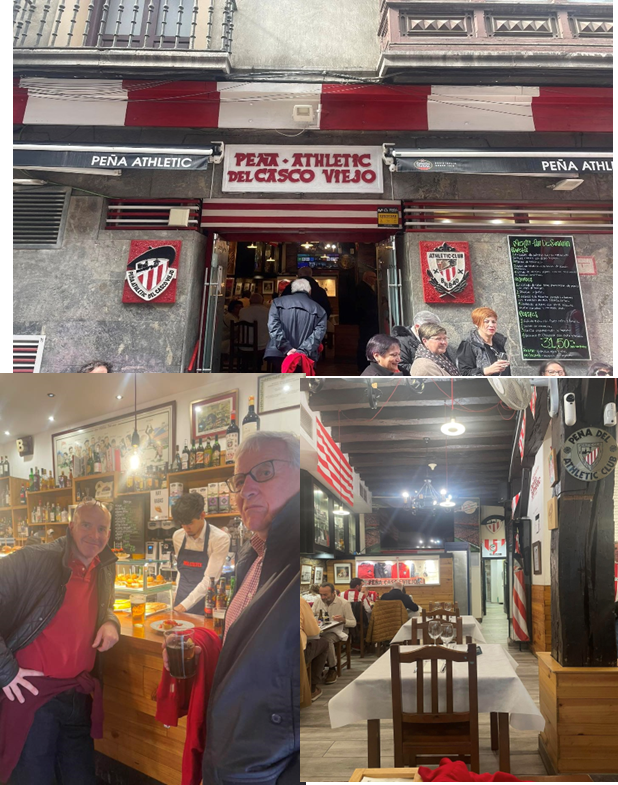
Peña Athletic del Casco Viejo Bilbao- not quite the same as our usual pre-match haunts.
Knowing that we had booked reasonably priced (at least compared to England!) VIP hospitality tickets, we were somewhat restrained in our consumption, but as the place filled up while we watched Atletico Madrid surprisingly lose away at Getafe on the large TV it proved to be an ideal way to get ready for the main event.
We had been planning on getting the tram through the city up to the ground, but the fun run that had been taking place earlier in the day meant that a lot of the roads were closed off, so we jumped on the metro and were at San Mamés less than half an hour after we had left the bar.
Unique is a word that is often overused, but in the case of Athletic Club de Bilbao it feels completely appropriate, at least in describing the club’s philosophy. As the most significant and well-known club in the region’s biggest city, Athletic Club (note it’s always the English version, never the Spanish version Atletico for historic reasons) draws its support from all over Basque country and has a strong role as a symbol of Basque nationalism and pride. Like many cities around the world with just one major football team, the fanbase is incredibly passionate and proud of its club.
As many will know it is the self-imposed Basque-only recruitment policy that is the element that makes it truly different. While they have stretched that rule somewhat over the years, it remains very much in place. In the money-mad world of modern football with its eye-watering transfer fees and player salaries, with squads comprising players drawn from all over the globe, it almost defies logic that a team would “handicap” itself with such a policy. Yet Athletic have remained more than competitive throughout their history. They are the fourth most successful club in terms of league titles won with 8, have never been relegated from the top flight, have won the Copa Del Rey 24 times second only to Barcelona, and this last season finished fourth in the league and but for an uncharacteristically poor performance against Manchester United in the semi-final might have been contesting the Europa League Final in their own stadium.
Their original San Mamés ground (sadly I never got to go there) was dubbed “La Catedral” due to the devotion shown by the club’s fans and the location on a site of religious heritage. The new stadium, although still on the same plot of land, can of course never recreate the magic and mystique of its predecessor but is one of the best new builds I have had the pleasure of visiting. It creates a genuine cauldron-like atmosphere where others can come across as soulless. (For anyone wanting to read more about this special club, I would highly recommend “Los Leones” by Christoper Evans referenced earlier.)

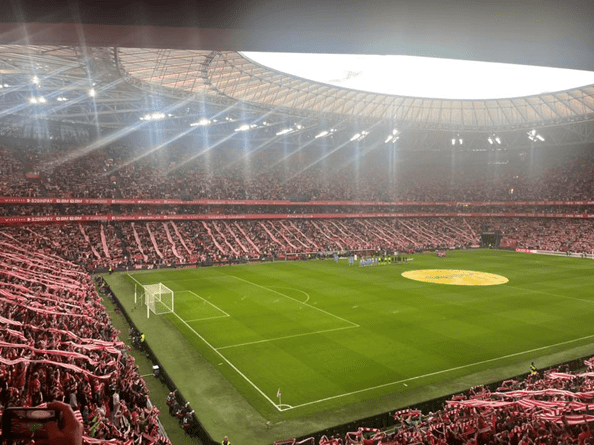
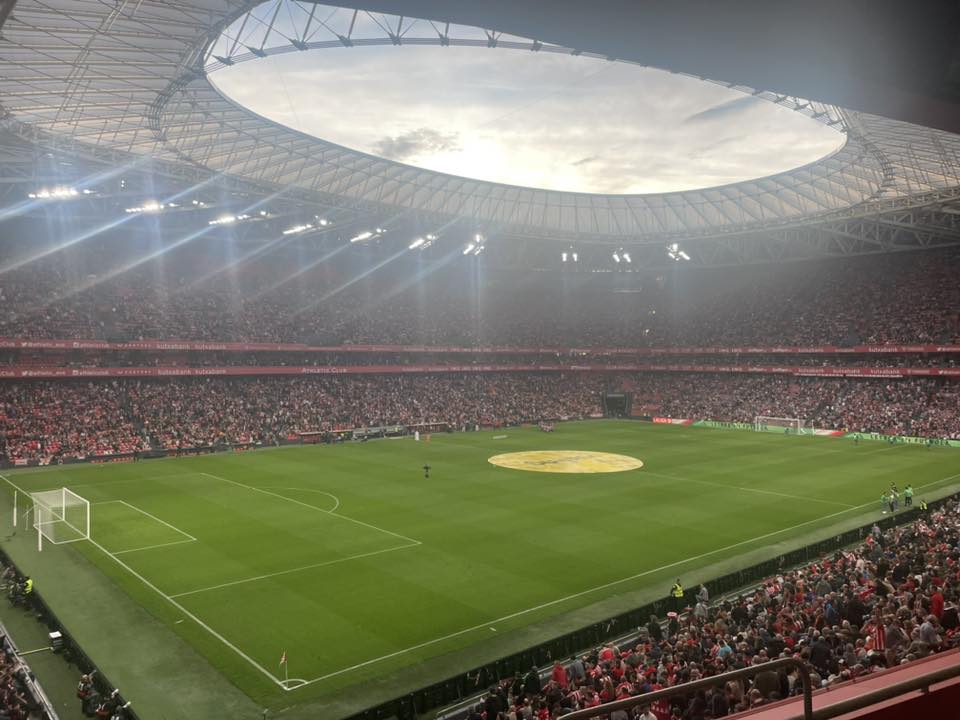
The “New Catedral” in all its Glory!
The VIP facilities were akin to Club Level at the Emirates, Wembley and the Tottenham Hotspur stadium, although the key difference was that unlike their UK counterparts the food and drink was not only free but in plentiful supply. Dad wasted no time in exploring the options, well it was his birthday treat after all! As I had experienced on a trip to Camp Nou in similar facilities a good few years ago, despite there being a fine array of local cuisine options, it was the mini hamburgers that were to prove the most popular.
Much to our delight the Athletic squad featured both Williams brothers, Inaki and Nico, although Inaki started on the bench. For those who aren’t familiar with their story: their parents undertook an incredibly dangerous journey from Ghana to Spain across the Sahara desert on foot seeking a better life. They eventually settled in Bilbao where the brothers were born and ended up both playing for Athletic. While Inaki opted to represent Ghana on the international stage, Nico became a star of the Spain team that won Euro 2024.
As the teams emerged from the tunnel the crescendo of noise was simply amazing, even those of our party who are regulars on Anfield’s famed Kop seemed to be suitably impressed. All around the ground people were belting out the club’s anthem while they waved their flags and twirled their scarves around their heads, while those of us who didn’t know the words simply mimed along.
The match itself was evenly contested but without too much in the way of goalmouth action. Early in the second half Antonio Raíllo gave Mallorca the lead with a thumping header from a corner. It didn’t seem to dent the home fans’ spirits in the slightest, if anything they raised their noise levels further to encourage their lads on. It seemed to work as just a couple of minutes later Nico Williams got on the end of a looping cross from the right and tapped home from close range.
Sadly Athletic couldn’t find the winner and had to settle for a point, although I think it is probably fair to say they had gained three new British fans. After the match we had a quick drink while we let the crowds clear a bit, in part though that may have been the three of us not wanting our weekend to end.
When we got back to London we all agreed that we should definitely make it an annual event, the only decision to be made is where we will be headed next year. There are those cities on the shortlist that didn’t make the final cut, many many other options, but something tells me Bilbao and the Basque Country might have quite some pull again.
Aupa Athletic!
 football nerd
Wonderfully lucid description of a great weekend.
LikeLiked by 1 person
Thanks although of course it was all your doing that we went in the first place!
LikeLike