
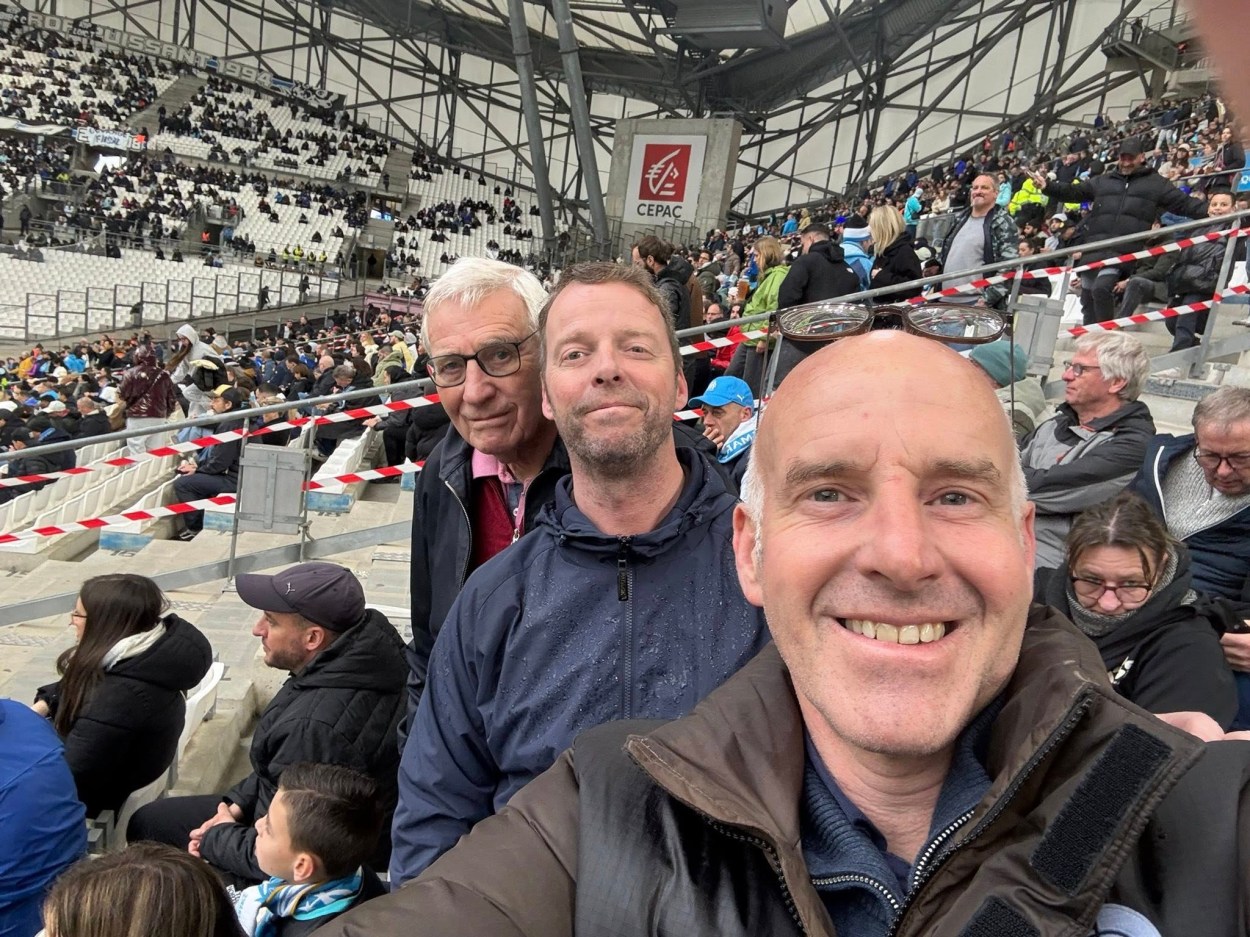
After all the fun of our trip to the Basque country last year (Three Football Obsessives visit the Basque Country), my dad, Our Kid and yours truly had pretty much decided before we even touched back down in London that we would do it all again the following season. Surprisingly, it was my 81-year-old father who came up with the suggestion of Marseille, a city that your author spent a year living in immediately after leaving school.
After finishing my A-levels in the summer of 1991, it then came down to picking a university. My preferred choice was Middlesex Polytechnic (as it was then called), as it offered a degree combining Business Studies (one subject I was actually interested in) and French (a subject that I was fairly competent at). However, what I didn’t realise immediately was that it combined studying half of the course in London and the other in…wait for it…the Mediterranean port city of Marseille. Seriously? What were the powers-that-be thinking sending a rebellious teenager to Marseille of all places? Not only that but I was going to benefit from a grant from the European Union to boot, very happy days indeed!
My arrival in France’s oldest and second largest city coincided with a great but also controversial period in Olympique de Marseille’s (the city’s sole and incredibly fervently supported major football club) history. In 1986 the club was very much on its knees financially and flirting with potential relegation, until, in a deal facilitated by the Mayor of Marseille Gaston Defferre, controversial Paris-based businessman Bernard Tapie purchased it for the nominal fee of just 1 Franc.
Tapie’s ambition sparked the club into assembling arguably the greatest collection of players in French football history, well at least up to that point. The first big names to arrive where West Germany defender Karlheinz Förster and attacking midfielder Alain Giresse, a member of the France team that won the European Championships on home soil just a couple of years previously.
In the following years Tapie would go on to recruit other high-profile players including Jean-Pierre Papin, Enzo Francescoli, Dragan Stojković, Chris Waddle, Trevor Steven and many many more. They won the French Championship four seasons in succession between 1988/89 and 1991/92, and in 1991 were beaten by an unexpectedly obdurate Red Star Belgrade on penalties in the European Cup Final.
Eventually in 1993 L’OM achieved Tapie’s and the club’s main goal by beating the great AC Milan side that included Franco Baresi, Paolo Maldini, Frank Rijkaard and Marco van Basten 1-0 to win the inaugural Champions League Final in Munich. However, they were stripped of the title a year later as the result of an investigation into financial irregularities and match fixing, they were also demoted to the second division back in France.
While L’OM won their way back to Ligue 1 in 1996 and went on to win another league championship under former player and current France national team manager, Didier Deschamps, in 2008, the PSG-skewed nature of top-flight French football means that they haven’t been able to get anywhere near their previous dominance in recent times.
Despite being a poor student at the time, I managed to go and watch L’OM (as they are known by literally everyone in the city) on a few occasions in 1991/92 and it was always a truly awe-inspiring experience. Not just for the quality of the football, but for the atmosphere that the different ultra groups create on the virages (terraces) behind each of the goals.
Inspired by ultra culture in Italy, Commando Ultra 84 and South Winners were the first groups established amongst the OM fanbase and have since been joined by several others. The atmosphere they create is passionate, fervent and whole-heartedly about backing the team, although if they are not happy about things at the club, they are not exactly backward in coming forward in letting the powers-that-be know their feelings!
In a similar manner to the approach in Spain, Ligue 1 fixtures are only confirmed at pretty much the last minute, so as for the trip to Bilbao we decided to head out on Thursday and return on the Monday, thereby ensuring that we would definitely be there for whenever over the weekend the fixture against Lille would take place. As it was to turn out it was scheduled for the Sunday evening, giving us the Friday and Saturday to do a bit of exploring of the wider region.
The flight only takes just over an hour and a half and thanks to Our Kid’s better half, Suzie, who runs her own travel company, our driver was wating for us at the airport. It doesn’t take very long to get to the city centre and we were chuffed to find that our selected hotel was a brief stroll to Le Vieux Port (literally: Old Port)– the city’s old harbour and main cultural centre which is surrounded by bars, cafes, a wide range of restaurants of all sorts of cuisines, as well as the odd nightclub (which I may or may not have frequented during my student days funded by the EU!).
After settling in and benefiting from the free coffee available all day in the hotel’s restaurant, we headed down to the Vieux Port to catch up with that evening’s round of European football fixtures before dinner at a restaurant recommended by our driver. Thanks to Our Kid’s IT skills (yes, he asked ChatGPT!) we found a great sports bar just a few doors down from the restaurant in a square just off the harbour side.
We knew this was the perfect venue for us because as soon as we walked through the door, we noticed the doormat wrapped in a Paris St Germain jersey with patrons encouraged to wipe their feet thoroughly on it before entering. For those not au fait with the rivalry between L’OM and PSG it goes back further than simply the takeover by Qatar Sports Investments in 2011.
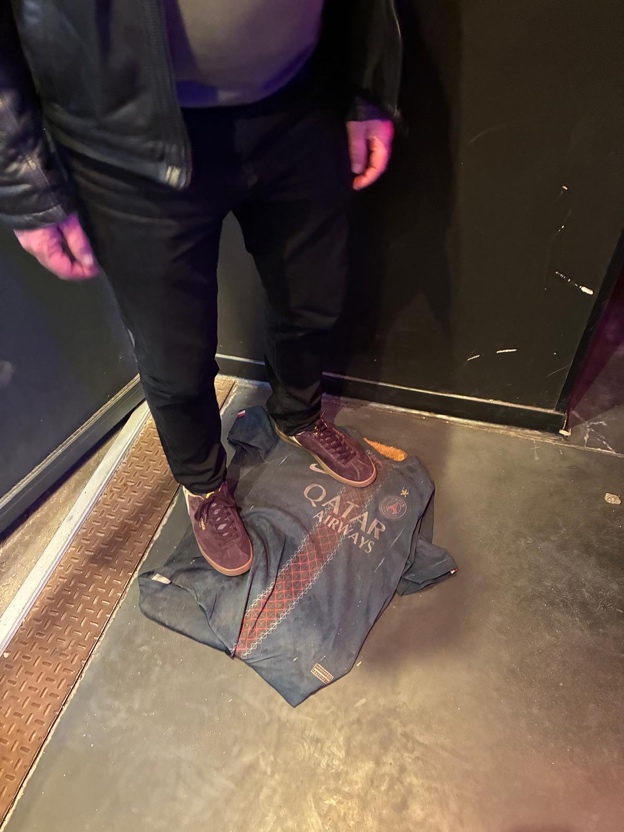
The ideal use for a PSG shirt
After PSG’s foundation in 1970, the rivalry really gained momentum in 1986 when PSG won their first ever league title and Marseille were taken over by Tapie. As we know this was a period of Marseille domination while PSG and Arsene Wenger’s Monaco were their main rivals for the title.
The animosity between France’s two most prominent clubs is based on more than just the football though, it is very much founded on the historical, cultural and social differences between the two cities. Marseille sees itself as a rebellious, multi-cultural port city whereas Paris is seen as elitist and arrogant. While slightly different from that in England, the north-south divide in France is a very real thing.
After a fun evening and an excellent meal, on Friday we were up and out early as we had decided upon a daytrip to Arles- a city on the Rhône River famed for its Roman monuments and deep connection to a certain Vicent Van Gogh.
After a quick pit stop for a coffee and croissant in the bakery immediately across the road, which was packed as it was Eid and those who had been fasting for an entire month were clearly relishing the opportunity to treat themselves to a decent breakfast during daylight hours, we strolled up towards the station.
Graffiti from one of L’OM’s Ultra Groups: MTP94 (Marseille Trop Puissant 94)
It takes about 45 minutes on the train from Marseille to Arles and the route is very picturesque. Once we arrived it was noticeably warmer than we had anticipated, a welcome development but it did mean that we were carrying our jackets and rolling up our sleeves for most of the day.
We had a stroll along the riverside walkway, visited the amphitheatre (as featured in the movie Ronin, one of my all-time favourites) and other Roman remains and went to have a look at the site of Van Gogh’s famous painting “Café Terrace at Night”, before settling down to a hearty lunch at an excellent family-run restaurant down a side street.
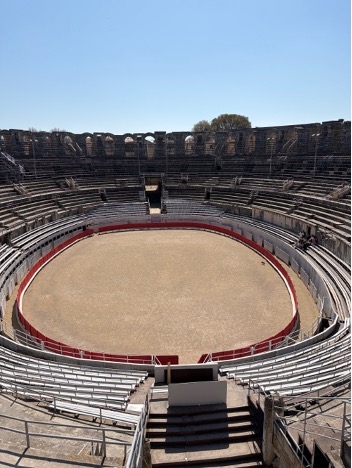
The amphitheatre at Arles
With time to kill before our train home we settled into a bar near the station where Our Kid taught my dad and me a card game called “Sh*thead” after hastily running over to a nearby supermarket to purchase a pack of cards. Whether he was deliberately trying to engineer victory for himself by not explaining the rules fully is unclear, however it somehow backfired as he finished last in each game we played.
Once back in Marseille, with the three of us all still a bit full-up from our lunch, we popped down to an Italian restaurant on a backstreet just off the Vieux Port and were all relieved that the plates of ravioli we ordered weren’t huge, although they were very tasty.
On Saturday morning we were up and out even earlier than the previous day as we had rugby-watching plans in Toulon. Having learned how steep and lengthy the walk up the hill to the station was the previous day, I drew on my “expert” local knowledge and guided us there via the city’s small but very useful metro system. After a breakfast of coffee and croque-monsieurs (basically the French version of a ham and cheese toastie but way more gastronomic, as I am sure the French would tell you!) all round, we boarded the train and set off for Toulon.
We arrived in the historic port city mid-morning and the first thing we did was get a taxi to the Mont Faron cable car. Mont Faron is the mountain that overlooks the city and harbour down below. At the summit is the Allied Landings Museum detailing, particularly, the Allies’ liberation of the South of France from Nazi occupation towards the end of World War II. The museum tells a story from the war that isn’t as well-known as events such as D-Day, and the views from the top of the mountain are spectacular.
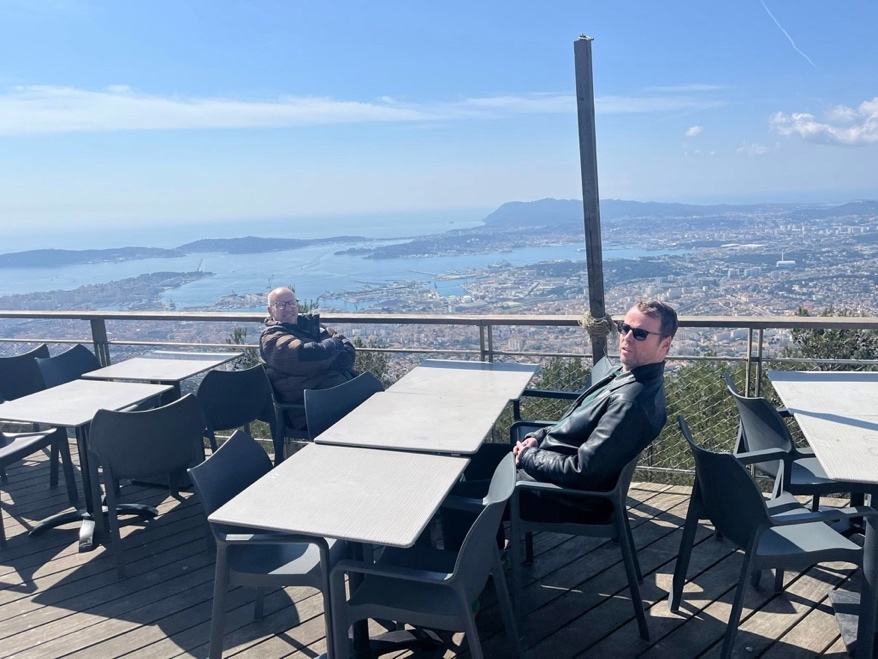
Our Kid and yours truly awaiting a coffee with a view at Mont Faron
Once we had finished at the mountain and taken the cable car back down, we grabbed another taxi, this time down to the National Maritime Museum which details the history of the French Navy, Toulon having been France’s primary Mediterranean naval base since the 17th century. As interesting as the museum is, when you have spent a significant period living on Merseyside and with one of us living opposite Greenwich in London, it is perhaps not as impressive as others we have visited.
With our second museum of the day completed (as a reminder: Dad and Our Kid are addicted to museums!) it was time to find somewhere for lunch, and for those members of our party who are Liverpool fans, ideally somewhere to watch the Reds take on Brighton in their lunchtime Premier League fixture, so we headed down to the old town.
Unusually there was no sign of the kind of bar / Irish pub with food that we were hoping for, and we eventually ended up in a café just across the road from the rugby ground, that seemed to specialise in sandwiches, coffee and huge very sweet desserts. Sadly, for yours truly there was no beer and in even worse news for Dad and Our Kid there wasn’t even a TV, let alone the Premier League coverage they had been hoping for. In the end they watched the match on Our Kid’s phone while I sipped my Coca-Cola and watched the crowds build up on the way into the stadium.
Rugby Union is massive in the South of France, with crowds normally being in five figures and RC Toulon regularly selling out their Stade Mayol. In fact, their bigger matches, such as those against rivals Toulouse, are often switched to L’OM’s Stade Velodrome where crowds can reach 60,000. The fans are incredibly passionate with a highly entertaining band providing the soundtrack from a couple of hours before kick-off right through the match. In this encounter RC Toulon were taking on Stade Francais from the French capital and as we took up our reasonably-priced seats the place was pretty much packed already.
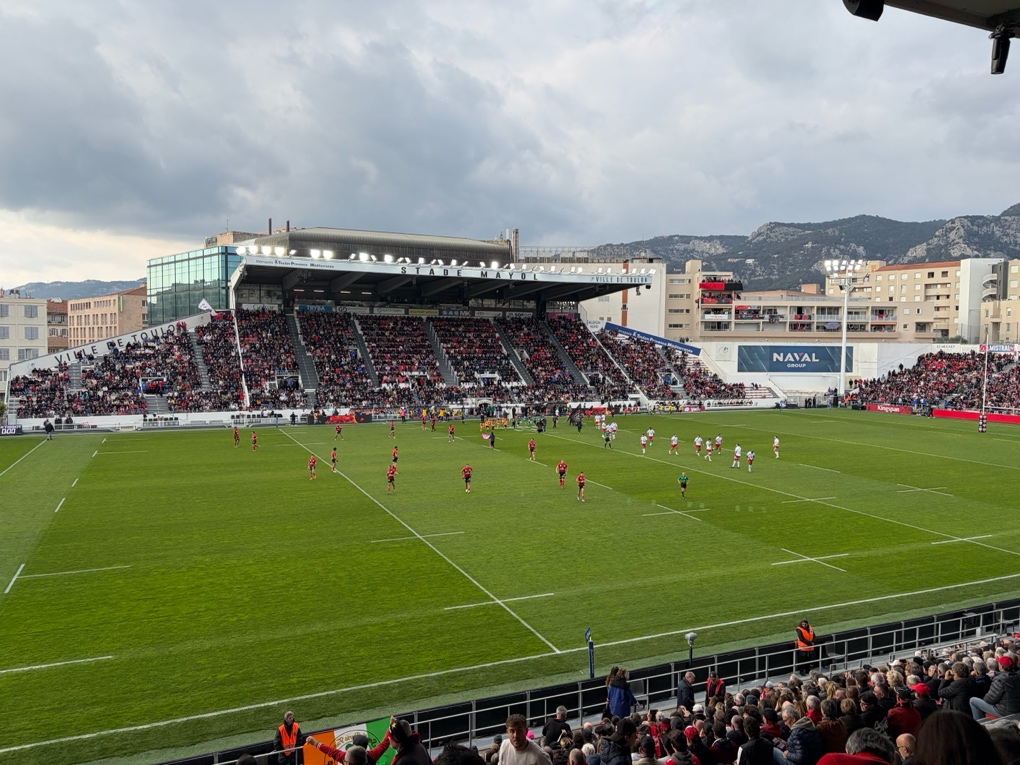
Matchday at the Stade Mayol
As a staunch Rugby League fan, I have always struggled to get into Rugby Union properly, but credit where it was due this was a highly entreating match-up with plenty of tries and incident including three sin-binnings. In the end it finished 46-27 in favour of the visitors, while the result may have been disappointing the match itself and the experience certainly hadn’t been.
As we meandered our way back to the station, we passed not one, but two, Irish bars showing Premier League football, still with Liverpool having lost 2-1 maybe the chaps were happier in the café after all.
After a slight miscue when we found out we had initially booked a train from, rather than to, Marseille, we arrived back in town with just enough time for another excellent meal washed down with a Pastis each for Our Kid and me. For those that haven’t yet encountered Pastis, it is an aniseed flavoured spirit that is popular in the South of France, especially Marseille. It is ridiculously strong, so much so that it is highly recommended that it is mixed with water, and there is a famous Marseillais saying which you sometimes see in bars, which states: “Le pastis, c’est comme les seins. Un c’est pas assez, mais trois c’est trop!” (Pastis is like breasts: one isn’t enough, but three is too many!).
Sunday was matchday and with plenty of time to kill before the late afternoon/ evening kick-off we decided to have breakfast up at one of my old hangouts from my student days, Cours Julien. As seems to be happening all over the world this bohemian neighbourhood that was always a bit rough and ready has become trendy. Just about every available external surface is plastered with graffiti and it is filled with independent shops, second-hand boutiques, and a whole range of quirky cafes and bars, like Camden, Shoreditch etc in London.
We found a suitable place for a coffee and something to eat while we waited for the rain to dissipate before strolling back down the hill via Noailles- a neighbourhood filled with North African shops and stalls selling a whole range of foodstuffs, spices etc, and then strolled around the town.
Having for once planned ahead, we had pre-booked a table at Brasserie L’OM Café down at the Vieux Port for lunch. The restaurant is operated by the club but feels much more like a traditional French bistro rather than the sort of place you might find at a typical British football ground. After a very civilised lunch in which my dad sampled the local speciality dish bouillabaisse – basically a very tasty fish stew invented in Marseille with the precise type of fish used dependent on how the fisherman had got on in their most recent ventures out to the Mediterranean, it was time to head up to the ground.
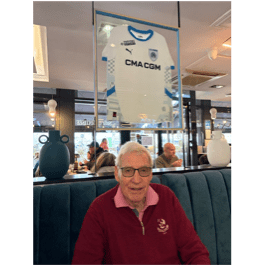
Dad enjoying a “sophisticated” lunch at Brasserie L’OM
Even though the restaurant is down at the Vieux Port, it is very easy to get to the Stade Velodrome by metro, with the entrance to the station being almost literally outside the restaurant. Definitely good news as the rain had ramped up another gear or two while we were enjoying our lunch.
You need to change trains at Place de Castellane and then get off at Rond Pont De Prado, which is virtually outside the stadium. Or at least it used to be. Such has been the development of the stadium and surrounding area that instead of just the one metro stop, the next stop, Sainte Marguerite is handier for the other side of the ground.
Having been way too blasé due to my “local knowledge”, we hadn’t even looked to see where we were sitting and, as a result, had to trek all the way round the ground through some scrubland in the persistent heavy rain. There’s clearly a lesson to be learned there!
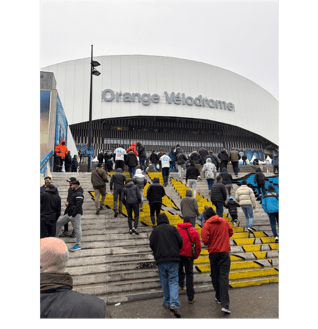
The main (but unfortunately not our!) entrance to the Stade Velodrome
Once we had finally reached the correct stand, as soon as we entered the turnstiles there were two shifty-looking characters mumbling softly about the Virage Sud, the south terrace being very much the most lively and vibrant part of the ground.
As outsiders are not allowed to buy tickets behind the goals, when I had been there several years previously with the missus, we had simply asked a policeman if there was any way we could access the (in)famous terrace? In response he simply wandered away after nodding discreetly towards an unlocked gate. Now it seems the ultras have created their own cottage industry by offering those marooned in the more sensibly behaved areas of the stadium the chance to come and experience the true atmosphere, for a fee of course! Being totally honest, I think the three of us were tempted just for a second before deciding that at our respective ages we were better off in the posher seats.
The stadium itself was hugely impressive back in the early 90’s, but after two periods of development: one before the 98 World Cup, the other before Euro 2016, a simply stunning football ground has been created. Even though the virages are now technically all-seater (although of course no one pays a blind bit of notice to that!), all four stands are huge and steep and topped off by a gigantic roof that really serves to keep the noise in, making for quite some atmosphere. Even an hour before kick-off there was incessant cacophonous drumming combined with fiercely loud non-stop chanting and firecrackers exploding every 30 seconds or so.
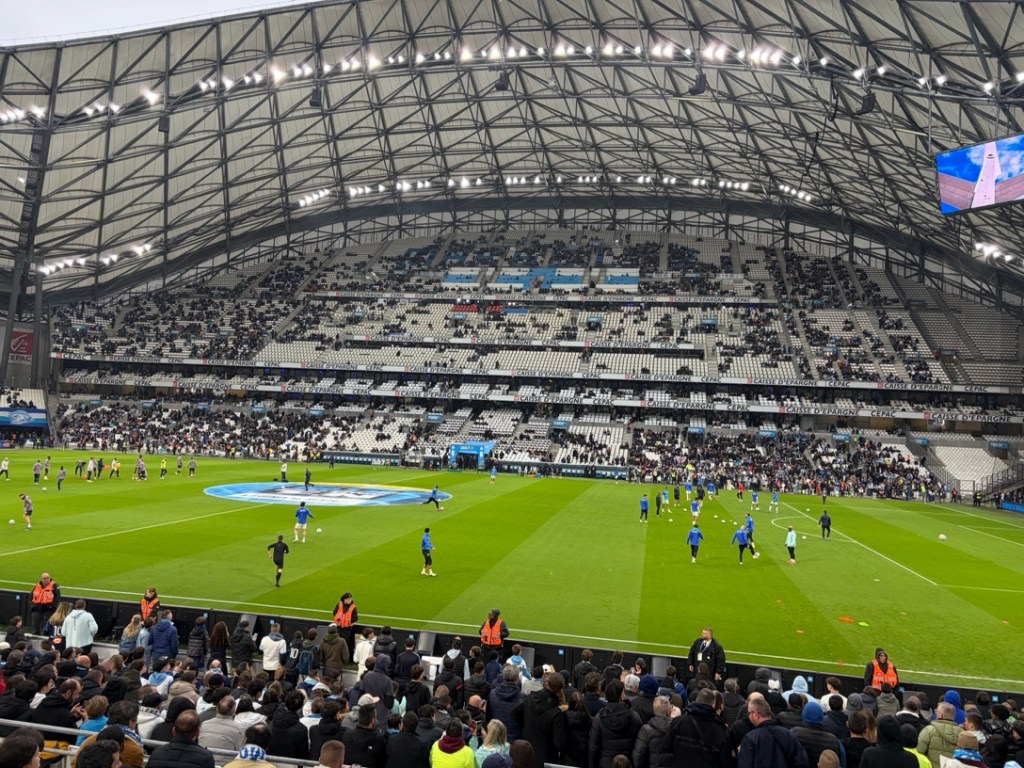
The atmosphere starts to build as the players warm up
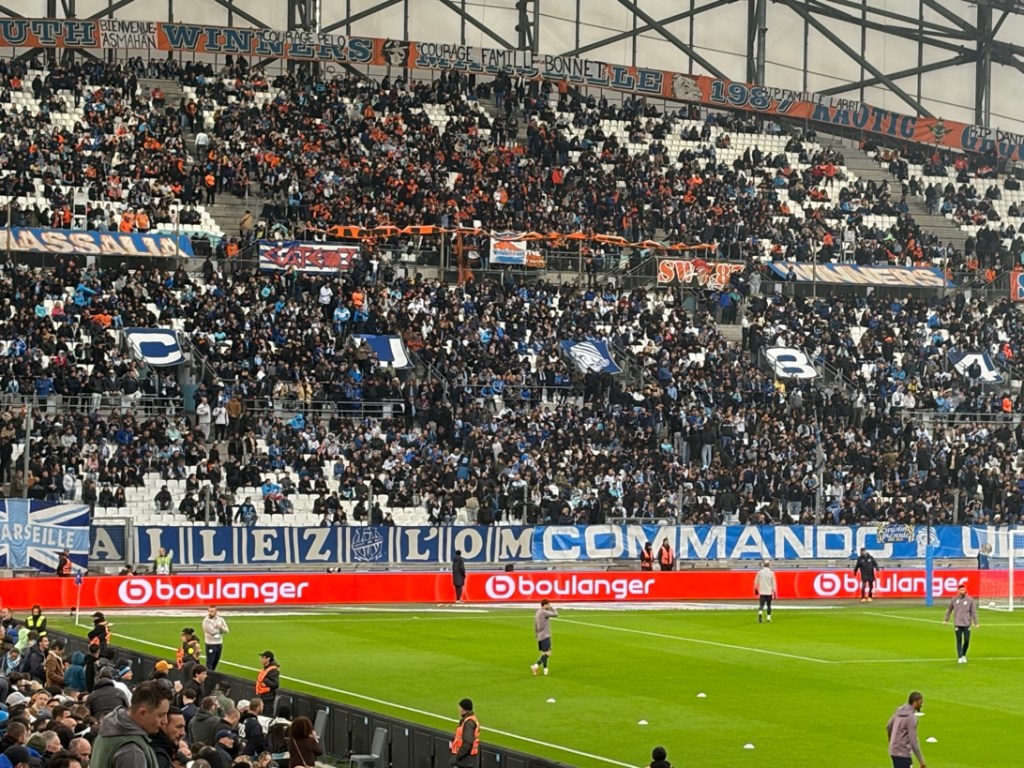
The Virage Sud is match-ready
When the teams emerged to the traditional, but never explained, strains of Van Halen’s “Jump” the noise seemed to increase a level or two even further. The visitors LOSC Lille were also in the hunt for European qualification like L’OM, however the huge distance to travel, the kick-off time, and the tendency for the majority of French football fans not to follow their teams away from home (Marseille and PSG very much excepted), meant that we couldn’t actually spot an away section anywhere in the ground. When I had watched Lille here previously, they had rustled up no more than 14 hardy souls for an even later Sunday evening kick-off.
There were several familiar names in both squads especially for those of an Arsenal-supporting perspective: Quinten Timber brother of Jurriën, former skipper Pierre-Emerick Aubameyang, and teenage loanee Ethan Nwaneri were in L’OM s. While quite possibly the world’s luckiest footballer, a certain Olivier Giroud, was on the bench for Lille. Highly controversial signing Mason Greenwood started on the right wing for Marseille.
Once the match kicked off the atmosphere became even more fervent. It wasn’t long before the two virages engaged in the renowned “Aux Armes” (Call to Arms) chant. In which both ends of the ground take it in turns to chant at each other: “Nous sommes les Marseillais [We are the Marseillais} … et nous allons gagner [and we are going to win].” It is inspirational just watching it but being in the middle of it is simply spine-tingling.
It was a lively and evenly matched start to the game, with both teams looking to get in behind the other. 15 mins in Greenwood was clattered by a challenge as he looked to break downfield which resulted in him having to be replaced by Nwaneri. To my delight it was the Arsenal youngster that opened the scoring just before half-time, driving onto a cutback from the left and firing home. So far so good.
The visitors got off to the perfect start in the second half when Belgian forward Thomas Meunier equalized just four minutes in. From there it was all about which team could carve out a chance to take all three points. When Giroud replaced Félix Correia with just over 10 minutes to go, I must admit that I had something of a sinking feeling in my stomach, just knowing that if anyone was going to decide this match, it was going to the veteran World Cup and Champions League winner.
Sure enough, with just 4 minutes remaining Giroud did what he does best leaping to reach a cross from the right and finding the back of the net with his header. You could almost feel the deflation all around the stadium.
After the match as the players went to applaud the Virage Sud, they were roundly booed and given a load of abuse. It wasn’t just the performance in this match; discontent had been growing for a while over the club’s direction. After a decent enough start to the season L’OM’s elimination from the Champions League by Club Brugge, and a 5-0 hammering away at PSG in the early part of 2026 led to Roberto De Zerbi’s departure by mutual consent and were seen as the point where yet another season had started to go off the rails.
There is an ongoing feeling that the club under its current ownership is continuing to fail in its ambitions and remains a long way behind their rivals from the capital. Then again, as they say in France: “plus ça change, plus c’est la même chose” (the more things change, the more they stay the same)- it really wouldn’t be L’OM if there wasn’t some form of ongoing drama.
After the match we headed back to the Vieux Port for one more excellent dinner and spent much of it debating where we might be headed next season. Already anywhere in Germany, Warsaw and Madrid are emerging as the early favourites, however that will inevitably change as the months tick on.
 football nerd
Hi GarethGreat account of a most enjoyable weekend.DadSent from my iPadOn 11 Jun 2026,
LikeLike
Brilliant reminiscing on a great trip. If anyone needs help booking a similar trip, give Suzie a shout on the link below.
https://l.instagram.com/?u=https%3A%2F%2Flinktr.ee%2Fsuzieptravel%3Futm_source%3Dig%26utm_medium%3Dsocial%26utm_content%3Dlink_in_bio%26fbclid%3DPAZXh0bgNhZW0CMTEAc3J0YwZhcHBfaWQPOTM2NjE5NzQzMzkyNDU5AAGnZRE4hIcU-xDczZnxNwQkkhfTBB0CpL_YOqvqC3IVpGnSbwD1jnmpqZmfoSk_aem_VdrRGglkPtfRqiTtQhHe0w&e=AUA_EqkmDAxemITfFGh2HG7GnKtFxPYDmOseF2xlbIQdFpC57dKoCmM6cs5_kD-URUmp72M_Oi1sBSdOh3WBBkzAfEoG3XAQmh1PnLZ1E2EXxZ_1ssrXGY3yX4HQZ37QQpNww4eq-wzFTQNDp8sR2ZU
LikeLike